

Article: Melasma: understanding these patches and caring for your skin
Melasma: understanding these patches and caring for your skin
(adapted from the French)
You have noticed brown or greyish patches settling on your cheeks, forehead or upper lip, often symmetrically on both sides of the face. This may be melasma. It is common, especially in women, and it is not a health risk. Melasma does ask for patience and a steady approach. Here is what to understand, and how we approach it at the clinic.
What melasma is
Melasma is a form of hyperpigmentation. Certain skin cells produce more melanin, the pigment that gives skin its colour, which forms darker patches. They most often appear on the cheeks, forehead, nose and upper lip. The edges are usually soft rather than sharp, and both sides of the face are affected fairly symmetrically.
Melasma mostly affects women between 30 and 55, and skin that tans easily is more prone to it. It is neither contagious nor painful. It is first and foremost a question of appearance, and of feeling at ease with your reflection.
Why it appears
Three factors come up almost every time.
The sun is the first. UV rays, even on grey days and even through a window, drive melanin production. That is why melasma darkens in summer and returns year after year when skin is left unprotected.
Hormones also play a part. Melasma often appears during pregnancy or with hormonal contraception, which is why it is sometimes called the mask of pregnancy.
Heat and a family predisposition round out the picture. Heat alone, without direct sun, can be enough to keep the patches going.
One thing deserves to be said plainly: melasma is managed, not cured like a cold. The realistic goal is to soften the patches, even out the complexion and, above all, help limit how much they darken. Consistency matters more than any single product.
Melasma or a simple sun spot
Melasma is often confused with sun spots, also called lentigines. Sun spots are usually small, well defined and isolated, and they follow the most exposed areas such as the backs of the hands. Melasma instead forms broad, symmetrical patches on the face.
The difference is not always obvious to the eye, and other skin conditions can look similar. If a spot quickly changes shape, colour or size, see a doctor without delay. That falls outside the scope of esthetic care.
What actually helps
Daily sun protection is the foundation, and by far the most useful step. A high-index sunscreen, applied every morning and reapplied through the day, all year and not only in summer. Without that habit, nothing else holds over time.
Next come gentleness and consistency. Skin prone to melasma responds poorly to harsh handling, heat and friction. A regular, well-suited routine gives better results than an occasional intensive treatment.
Be wary of quick-result promises. Melasma is stubborn. An honest approach aims for gradual, lasting improvement, not a one-session disappearance.
Our approach at Clinique Évia
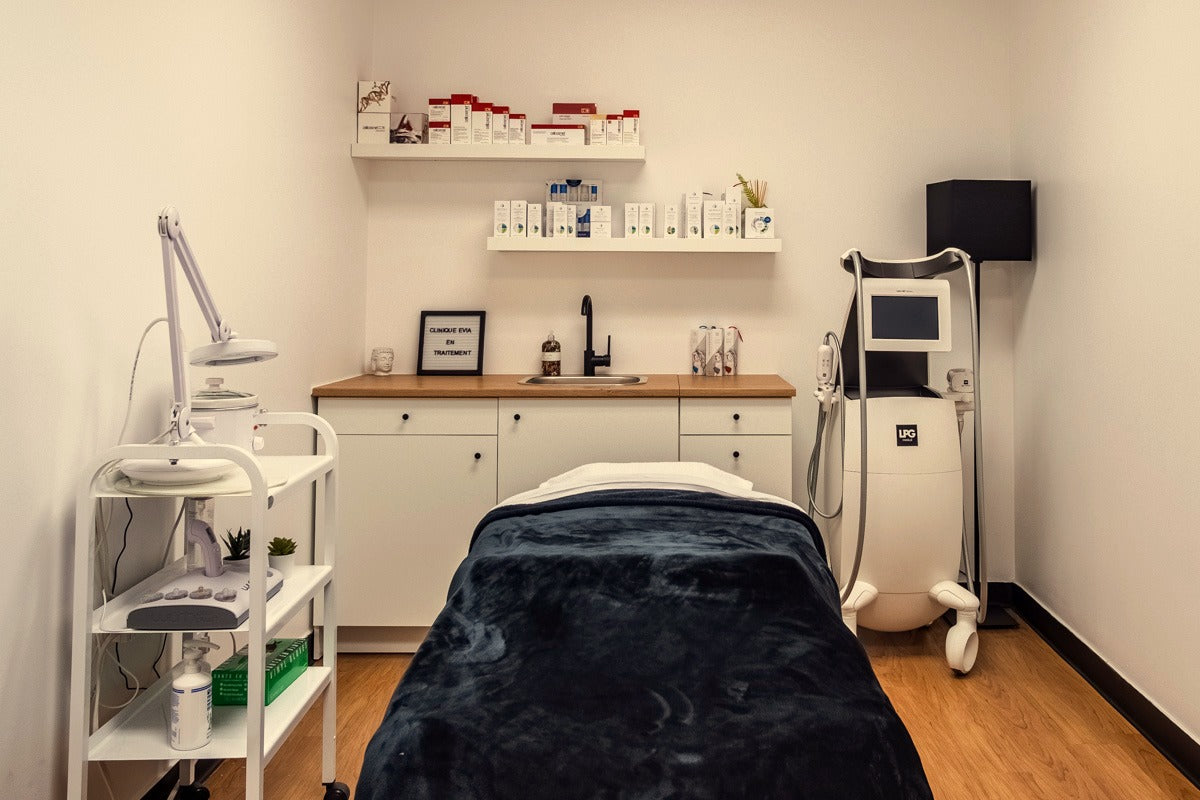
Everything starts with a conversation. During the free 30-minute consultation, we take the time to look at your skin, understand your history and habits, then build a realistic plan suited to your needs and your budget.
For an uneven complexion, our work sits within the esthetic scope: gentle care aimed at a more even tone, an at-home routine built with professional products from our selection, and above all guidance on sun protection, which remains the centrepiece. We move at your skin's pace, without harsh handling.
We also stay honest about the limits. Melasma can call for medical treatment in some cases. If that is right for you, we encourage you to see a doctor or a dermatologist. Our role is to support you, not to replace medical advice.
When to see a doctor
Talk to a doctor if a spot changes quickly, bleeds or itches, has a very irregular edge, or if you want to explore a medical treatment for pigmentation. Otherwise, steady esthetic support and good sun protection make a real difference over time.
Frequently asked questions
Can melasma disappear completely? It softens and is well controlled with consistency, but it tends to return if skin is not protected from the sun. We aim for lasting improvement, not a promise of disappearance.
Is the sun really that important? Yes. It is the number one factor. Daily sun protection is the most effective step, ahead of any product or treatment.
Where should I start? With a consultation. Every skin is different, and a tailored plan beats a generic routine found online.
Ready to see things more clearly
Your first step is a free, no-pressure 30-minute consultation in Pierrefonds, in Montreal's West Island. We look at your skin together and build a plan that suits you.